As an Amazon Associate, we earn from qualifying purchases. Some links on this site are affiliate links at no extra cost to you. Our recommendations are based on thorough research and editorial judgment.


How RC Sailing Works: Rigs, Sails, and Servos

RC sailing operates through a blend of rig types, dynamic sail control, and precise servo systems. Various rigs—like sloops and cutters—offer unique advantages in wind handling. Key components include the hull for buoyancy and the mast for sail support. Sail adjustments are essential, as they capture wind efficiently, while servos convert electrical signals into sail and rudder movements. With the right setup, a sailor can master maneuvers like tacking and jibing—ensuring smooth sailing ahead. More insights await.
Key Takeaways
- RC sailing utilizes various rigs, such as sloops and cutters, affecting handling and performance in different wind conditions.
- Sails capture wind energy for propulsion, with adjustments in trim maximizing efficiency and steering control.
- Servos convert electrical signals to mechanical movements, adjusting the sail and rudder based on commands from the transmitter.
- Key components include the hull, keel, mast, and rudder, all contributing to the boat’s stability and maneuverability.
- Mastering techniques like tacking and jibing enhances responsiveness to wind changes, ensuring better control and speed during sailing.
Understanding RC Sailing Rigs
Understanding RC sailing rigs is akin to mastering the art of a delicate dance, where precision and adaptability are essential. The diverse types of rigs—Sloops, Cutters, Ketches, Yawls, and Schooners—each serve a unique purpose and come with specific rig specifications.
- Sloop rigs offer simplicity with one mast and two sails, ideal for new sailors.
- Cutter rigs enhance handling with an added headsail, perfect for windy conditions.
- Multi-mast options like Ketches and Schooners present diverse balance techniques.
Rig customization allows enthusiasts to tailor their sails, adjusting aspects like luff tension with Cunningham rings. The choice of materials and mast options, such as the 11mm Round, plays a significant role in performance, granting both rigidity and flexibility. Additionally, understanding the importance of wind dynamics is crucial for optimizing sailing maneuvers.
Key Components of Sailboats
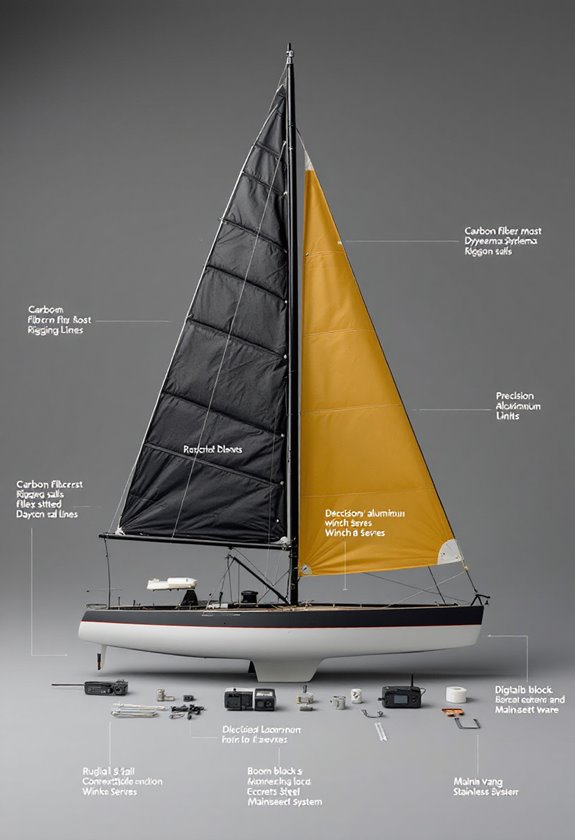
Sailboats, the graceful vessels gliding across serene waters, are composed of several key components that work together in perfect harmony.
- Hull and Keel: The hull serves as the backbone, ensuring buoyancy and shape, while the keel—often weighted—stabilizes against wind forces, much like a tree roots itself in soil.
- Sails: Made from lightweight yet durable sail materials, the mainsail and jib capture wind energy, propelling the boat. They adjust dynamically to varying conditions, similar to how a bird shifts its wings.
- Mast and Boom: These structures support the sails. The mast stands tall, while the boom controls angles—essential for effective wind capture.
- Rudder: Positioned at the stern, it steers the sailboat by redirecting water flow, ensuring precision in navigation.
Together, these components create a stunning interplay of design and functionality. Additionally, understanding the mechanical and control features can greatly enhance your sailing experience by providing insights into optimal performance and handling.
Types of Rig Setups
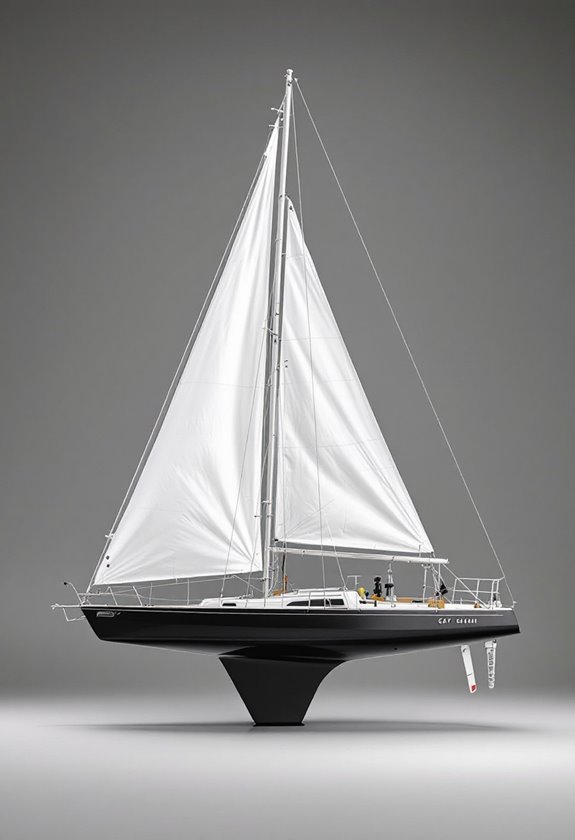
Rig setups play a crucial role in the performance and handling of RC sailboats, much like a tailored suit enhances one’s appearance. The most common types include:
- Conventional Rigs: Known for their fixed mast, these excel upwind with tight sheeting angles but struggle in gusty winds.
- Swing Rigs: Pivoting as one unit, these provide extraordinary maneuverability and power, especially in moderate winds, though they can be challenging to design due to sail material constraints.
- Gaff Rigs: They offer soft handling of gusts, great for aesthetics, but require more rigging effort compared to Bermudian types.
- Chinese Junk Rigs: Though less effective close-hauled, their simple reefing design shines in stability during strong conditions—ideal for leisurely sailors.
In choosing an RC sailboat, consider the sailing experience it offers, as this can greatly affect your enjoyment and performance on the water.
Careful design considerations facilitate peak handling characteristics in various wind conditions, making rigging challenges worth addressing.
Importance of Sail Positioning
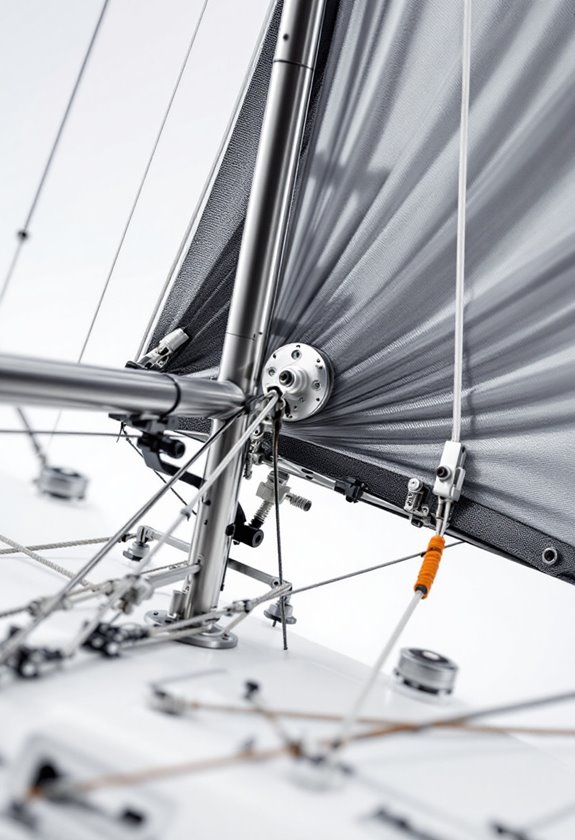
Sail positioning remains a pivotal aspect of RC sailing, profoundly affecting both speed and maneuverability. Correct placement of sails relative to wind direction directly enhances sail efficiency. Here are key positioning strategies to evaluate:
- Upwind Advantage: Maintain the boom just inside the stern’s aft corner to optimize speed and angle, avoiding that dreaded pinching.
- Tacking and Jibing: Adjust the sail angle during these maneuvers, ensuring momentum and balance are preserved.
- Downwind Dynamics: Letting sails out effectively captures wind, preventing stalling and drag. Additionally, understanding the impact of wind performance factors is essential for maximizing sail efficiency and overall boat handling.
The Basics of Sail Control

Understanding the fundamentals of sail control is crucial for anyone steering through the exhilarating world of RC sailing. Sail trim—the adjustment of the sails’ tension—plays a central role in harnessing wind effectively.
- Wind Angle Matters: Aligning sails with the wind angle enhances lift while minimizing drag.
- Sail Control Setup: The left stick on the transmitter manages sail trim, letting sailors pull in or ease sails—tight for upwind, loose for downwind.
Balancing rudder movements with sail adjustments is just as essential; for instance, a well-trimmed sail can mean the difference between a smooth sail and a capsized boat. With practice, sailors discover how small adjustments translate into big victories on the water, mastering the engaging dance of wind and vessel. Additionally, understanding how to adjust sail trim can significantly improve performance during competitive sailing events.
Jib vs. Mainsail Dynamics
In the intricate dance of RC sailing, the dynamics between the jib and mainsail hold the key to harnessing the wind’s power. The jib enhances mainsail performance by improving airflow dynamics, creating a slot effect that reduces stalled airflow. This relationship increases jib efficiency, as the lift generated by both sails drives the boat forward through a favorable pressure differential.
Rig tension plays a vital role in this synergy. Adjusting the jib boom lift tension guarantees peak sail shape, while careful management of tension aids in drag reduction. The difference in sail overlap between the jib and genoa further influences overall performance—smaller jibs excel in stronger winds, whereas larger genoas offer more power but add complexity. Additionally, understanding brushless motors in RC boats can provide insights into optimizing performance and speed in various sailing conditions. Understanding these dynamics is fundamental for maximizing RC sailing success.
Adjusting Sails for Optimal Performance
Ideal performance in RC sailing hinges on the art of sail adjustment, akin to fine-tuning a musical instrument for the perfect pitch. Sail adjustments cater to varying wind conditions, enhancing trim efficiency and sail stability.
- Light Winds: Increase foot curve to boost sail draft, while slightly reducing leech twist for consistent power.
- Heavy Winds: Minimize foot curve and increase leech twist to spill excess air, preventing capsizing.
Sail alignment is essential—ensure the leech aligns parallel to the boat’s centerline for synchronized luffing. Adjust rig tension to balance sail twist and flattening; backstay and vang work in tandem. Remember, effective sail handling is about mastering wind response—tweak those adjustments, and watch your performance optimization transform your sailing experience.
The Role of the Rudder in Steering
Steering a radio-controlled (RC) boat is all about the skillful role of the rudder, an unsung hero that transforms wind-driven power into seamless navigation. The rudder dynamics hinge on its size, ideally around 10% of the total lateral underwater surface area, guaranteeing ideal control response. Larger rudders enhance steering efficiency, but careful consideration of rudder materials—like plastic or brass—affects durability and flex.
Proper mounting techniques are essential; aligning the rudder vertically and close to the stern maximizes responsiveness. Linkage optimization, with robust components, guarantees smooth servo-to-rudder motion. Finally, performance tuning through trial and error allows sailors to balance rudder sizing and rake angles, crafting a vessel that feels alive on the water.
Recommended Products

Quality and Resistance: Made of high-toughness ABS in injection-molded simulation ratio, the model restores the realistic ship model with exquisite details, fine workmanship and natural coloration

All product accessories are ready, and users can set sail after assembling them by themselves.
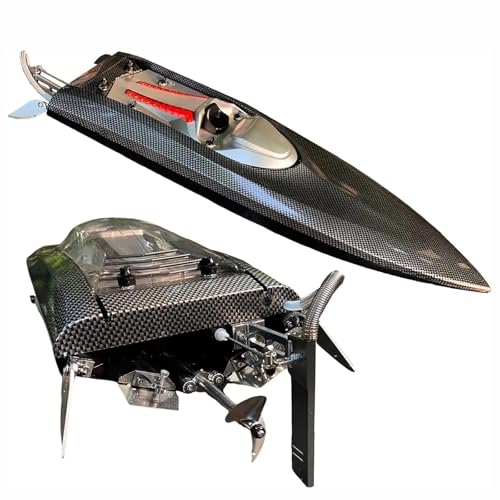
Dimensions: 630*170*110mm/25*7*4.3inch . Standard 11.1V 3S Edition .
How Rudders Influence Direction
The intricate interplay of a rudder’s design and placement directly influences how a radio-controlled (RC) boat navigates the water, shaping its overall performance. Rudder effectiveness hinges on size and shape; larger rudders enhance maneuverability but can create drag. Placement matters, too—stern-mounted rudders leverage hull length, improving steering precision.
When considering water flow interaction, best rudder angles maintain smooth flow, preventing cavitation. For performance enhancement, dual-rudder systems adapt to heel angles, offering directional stability and improving responsiveness in changing conditions.
Ultimately, the right combination of these factors leads to significant maneuverability enhancements. Consequently, mastering rudder dynamics can transform a standard RC boat into a high-performance vessel, gliding effortlessly through water with a finesse that would impress even seasoned sailors.
Servos: The Heart of Sail Control
In the dynamic world of RC sailing, servos play a pivotal role—acting as the beating heart of sail control. These tiny marvels convert electrical signals from the receiver into precise mechanical movements, adjusting sails and rudders to optimize performance. With various servo types available, sailors can choose models that offer high torque for breezy conditions or digital versions for unmatched servo precision.
- Functionality: Commands from the transmitter direct servos to shift the sail arm, essential for adapting to changing wind conditions.
- Installation: Servos easily connect with JR plugs, eliminating soldering hassles.
Ultimately, the seamless integration of servos impacts the maneuverability and speed of an RC sailboat, ensuring an exhilarating experience on the water—like a dance between technology and nature.
Types of Servos Used in RC Sailing
When commencing the journey into RC sailing, understanding the types of servos available can make a considerable difference in performance and enjoyment.
Recommended Products

Unmatched 100KG High Torque Performance- Boasting an incredible torque of 100kg/cm (1380oz-in), this servo is designed to handle the most demanding tasks in 1/8 and 1/10 RC crawlers, trucks, cars, buggies, and robotic applications, ensuring powerful and precise operation.

Brushless Motor & High Torque – Delivers ultra-high torque, fast response, and long-lasting performance.

Traxxas 2280 - 600 Series High Torque Waterproof Servo, 1/10 Scale
Servo Types
- Analog Servos: These offer basic functionality but lack the precision of their digital counterparts.
- Digital Servos: Featuring faster signal updates, they excel in torque consistency—particularly important in windy conditions.
Torque and Voltage
Higher voltage options, such as 6V compared to 4.8V, considerably boost torque output. For instance, specialized sail winch servos may need around 200 in/oz to handle strong winds effectively.
Popular Models
Notable examples include the Hitec Mega Sail Servo with 19.8 kg-cm torque and Hitec Winch Servo capable of 2700° rotation. Consider size—mini servos suit lighter boats, while robust, high-torque models cater to larger vessels.
Radio Control Systems Overview
Steering through the world of radio control (RC) sailing involves mastering an intricate web of components designed to work in perfect harmony.
Key Components:
- Transmitter (Tx): Handheld controller, providing channel configuration for rudder and sails.
- Receiver (Rx): Installs in the boat, ensuring power supply to servos while addressing signal interference.
- Servos: Mini motors execute servo adjustments for precise sail and rudder movements.
Power and Connectivity:
- Battery Types: Options like AA batteries or rechargeable lithium polymers—ensuring adequate power and connector compatibility.
- Waterproofing Options: Essential for protecting sensitive electronics from marine environments.
Maintenance Tips: Simplified wiring enhances performance and eases maintenance. While operational range may face limitations, effective antennas help mitigate signal loss, ensuring your vessel responds smoothly even in a crowd.
Recommended Products

SUBMARINE WATERPROOF: 7 Point Seals

High Torque High Speed

Transmitter Layout and Functions
Mastering the art of control is essential for any enthusiast of RC sailing, and at the heart of this process is the transmitter. This stick-type handheld unit boasts intuitive transmitter features, empowering users with control precision for sail adjustments and rudder steering. The left stick manages sail trim—pulling it in or letting it out—while the right stick directs the rudder.
Typically, at least two channels are dedicated: Channel 1 for rudder and Channel 2 for the sail servo. Advanced channel programming enables mixing, linking rudder and sail movements for smooth operations. Features like multiposition switches allow quick adjustments for various tacks. With effective servo calibration, each maneuver feels seamless, enhancing the sailing experience from the shore to the water.
Recommended Products

Excellent Anti-interference--DSSS&FHSS communication technology and 7dBi high gain antenna make AT10II transmitter with stable transmission signal and the control range is up to 2.5 miles(4km) in the air.

【Excellent Anti-interference】DSSS&FHSS communication technology makes AT9S Pro transmitter with stable transmission signal and long-range control up to 2.1 miles(3.4km) in the air.

【2.4GHz ELRS RC Transmitter with Nano Receiver】:Built-in ExpressLRS module, providing long-range, low-latency, and reliable connection for your compatible receivers. Perfect for FPV drones, RC multirotor, RC Helicopter,Fixed Wing,RC Cars, RC Boats, and RC Robots.
Mastering Sailing Maneuvers
Steering the art of RC sailing maneuvers can evoke a blend of excitement and challenge, akin to mastering a dance on water. Guiding through the intricacies of sailing physics is essential for effective maneuver timing.
- Heading Up: Pulling sails in helps maintain lift while steering toward the wind, keeping the boat agile.
- Bearing Away: Easing sails out allows for a smooth turn away from the wind, maximizing speed.
- Tacking: Mastering this requires a 90-degree turn through the wind, with smooth rudder movements to avoid stalling.
- Jibing: Executing this maneuver entails managing the boom shift with precision, avoiding jerky shifts.
Practicing these techniques will enhance a sailor’s ability to respond to wind shifts, ensuring the best control and speed.
Advanced Techniques for Better Control
Achieving advanced control in RC sailing elevates the experience from merely maneuvering a boat to orchestrating a dance with the wind and water. Sailors harness digital adjustments to fine-tune servo settings for precision—main sails command a remarkable throw from -70% to +70%, allowing nuanced sail control.
Key techniques include:
- Sail Trim Enhancement: Tighten sails upwind and loosen downwind to maximize lift and minimize drag.
- Weight Distribution: Position batteries strategically; moving them forward reduces nosediving, while placing them near the keel boosts speed.
- Wind Angle Mastery: Sail close-hauled for speed; anticipate wind shifts for ideal velocity made good (VMG).
With careful focus on wind dynamics, RC sailors transform their model boats into agile partners, steering the open water with flair and finesse.
Frequently Asked Questions
How Do Weather Conditions Affect RC Sailing Performance?
Weather conditions critically influence RC sailing performance by altering wind effects and water currents. Variability in gust strength, pressure gradients, and surface chop requires precise adjustments in sail trim and control to optimize speed and maneuverability.
What Materials Are Best for Building RC Sailboats?
Wood types provide traditional elegance for RC sailboats, yet plastic alternatives like PLA and PetG offer modern durability. This juxtaposition highlights the balance between craftsmanship and innovative materials in constructing efficient, reliable, and aesthetically pleasing models.
Can I Use My RC Boat in Saltwater?
Yes, using an RC boat in saltwater is possible, but it requires proper saltwater compatibility and corrosion resistance measures. Users must maintain waterproofing, regularly rinse the boat, and apply protective sprays to prevent damage.
How Often Should I Maintain My RC Sailboat?
Like a gardener tending to delicate blooms, one should adhere to a meticulous maintenance schedule for their RC sailboat. Following consistent maintenance tips guarantees longevity—rinse after every use, inspect weekly, and lubricate monthly to preserve performance.
What Are Common Mistakes Beginners Make in RC Sailing?
Common mistakes beginners make in RC sailing include improper sail trim, neglecting hull design suitability, and overlooking environmental conditions. These errors can impede control, increase damage risks, and diminish overall sailing success and enjoyment.


